Yea, I just picked CSC108H1 for Winter term, guess I will be updating this blog soon
When it comes to an end, I do find out that the second Project "Maze" has come up a little bit rush/fast right after the "Sneeze" Project, maybe it mean to put it that way or I just not used to this sudden tight arrangement of CS material.
And overall the material in these courses are light enough that I am able to focus on my life science course and still get a taste of what Computer Science is really about. Here, I do want to say a big apology to Prof Baumgartner since I didnt really come up to class the the past few weeks due to my heavy life science course load.
I will be considering to apply for Bioinfomatics as a specialist, however I am not so sure how does life science and CS come together, and what the image will be. Anyway, I am happy to finish my blog right here, and wish you a great marry christmas,
Best,
Monday, 1 December 2014

Friday, 21 November 2014
CSC104H1- Term Test 2 and Project Due
Finally, term test 2 is finished, and it's much harder than the past term test " I think", maybe I am still not used to the format of CS term test , or I am having another physiology term test on the same day and actually study the term test in the last minute... :P
And I do start to work on my first project "Sneeze", in which i don't find it as hard as I thought since the instruction is clearly state on each function, and what I should do is just put it together properly so that when I click one, things will go smoothly. And I do think the project does take qutie a bit knowledge from Mapping as well as defining function conditionally. Therefore I did spend quite some times opening previous lecture material to finish it.
And overall these few weeks material tends to be a bit light, or in other words, I AM MASTERING THE MATERIAL. Well, I do find this course much more interesting than I thought, especially when its not purely memorization like my life science courses, but using the reasoning as well as logical thinking.
The last but not least, have a good weekend~
Friday, 7 November 2014
CSC104H1 - Half way through, and project comes
There, project comes , "Sneeze" , and since I am more like a last minute person, I will just leave this part in my next blog since I didn't even start.
Lets reflect the material these few weeks, which is about Color, and some binary notation. To be honest, I don't understand binary notation and do find the course challenging as the time takes longer when I doing my Friday quiz. And for the "color" topic, it is more approachable to me since it can be "visualize in my brain" than a pure number from Binary notation.
Speaking of Friday quiz, I do find that the marks is a bit hard to follow up. Although the quiz will be return "once awhile", I think if we can keep track on our marks ONLINE like U of T Portal it will be much easier for me to stay on top of my material (Maybe there are updated mark online, and I just can't find it, well, if thats the case, my apology)
And recently I do start to play around with Dr.Racket, with some "orders", its just like a communication with my dog. "ERROR ERROR ERROR and ERROR", is what my result whenever I click run. And being this "straight" is what Computer Science really is, though nowaday we keep in touch with computer daily and don't see it as "straight". Its just simply Google, Apple or Facebook (I can't think of any others) makes the Computer Science too human friendly, much more easy to use.
But then Dr Racket is more like "core" of CS, and CSC104 is a touch of this "core" of Computer Science, because I do see how hard can it be if Prof Baumgartner throw some more binary notations in this courses :(
Anyway, overall this course is manageable and I do always look at the bright side!
Lets reflect the material these few weeks, which is about Color, and some binary notation. To be honest, I don't understand binary notation and do find the course challenging as the time takes longer when I doing my Friday quiz. And for the "color" topic, it is more approachable to me since it can be "visualize in my brain" than a pure number from Binary notation.
Speaking of Friday quiz, I do find that the marks is a bit hard to follow up. Although the quiz will be return "once awhile", I think if we can keep track on our marks ONLINE like U of T Portal it will be much easier for me to stay on top of my material (Maybe there are updated mark online, and I just can't find it, well, if thats the case, my apology)
And recently I do start to play around with Dr.Racket, with some "orders", its just like a communication with my dog. "ERROR ERROR ERROR and ERROR", is what my result whenever I click run. And being this "straight" is what Computer Science really is, though nowaday we keep in touch with computer daily and don't see it as "straight". Its just simply Google, Apple or Facebook (I can't think of any others) makes the Computer Science too human friendly, much more easy to use.
But then Dr Racket is more like "core" of CS, and CSC104 is a touch of this "core" of Computer Science, because I do see how hard can it be if Prof Baumgartner throw some more binary notations in this courses :(
Anyway, overall this course is manageable and I do always look at the bright side!
Friday, 31 October 2014
CSC104H1 - My first entirely written term test.
Well, since most of our life sciences term tests are using scan tron, therefore writing CSC term test is kind of "challenging" due to my used of fingers with "precise" movement. And I do find myself much of comfortable in doing CSC term test than any other courses. Not only because its easier, but I am actually using my hand movement with the reasoning in my head cooperate together, in which I am more confident with my answer. In contrast, filling out scan tron it just a pure brain reasoning, maybe I am a more "gesture learning" person.
In reflecting these couples week of CSC journey, which are the animation as well as the used of Apply and Mapping on list. I do find it a bit harder to get along with animation, the "big bang" thing due to the unclear explanation from Prof (to be honest, maybe I am just too dump). And when it comes to apply and mapping the list, I do find this topic is comfortable to approach and find it interesting.
The last but not least, the people in this class is dramatically disappearing, and I do wonder whats the reasoning in behind.
1) Too early (its 9:00 a.m., the U of T student biological clock is around 12:00 p.m) << I think
2) Too easy ( We can just simply download the material online and learn it our own, its more like a CSC104H1-Online style)
3) Herd mentality (Simply if too many people are leaving with good marks, why do I stay?)
And just a last piece of advice, I do believe cutting the lecture off and switch online version, and keep the tutorial quiz the same, it will be much more efficient!
In reflecting these couples week of CSC journey, which are the animation as well as the used of Apply and Mapping on list. I do find it a bit harder to get along with animation, the "big bang" thing due to the unclear explanation from Prof (to be honest, maybe I am just too dump). And when it comes to apply and mapping the list, I do find this topic is comfortable to approach and find it interesting.
The last but not least, the people in this class is dramatically disappearing, and I do wonder whats the reasoning in behind.
1) Too early (its 9:00 a.m., the U of T student biological clock is around 12:00 p.m) << I think
2) Too easy ( We can just simply download the material online and learn it our own, its more like a CSC104H1-Online style)
3) Herd mentality (Simply if too many people are leaving with good marks, why do I stay?)
And just a last piece of advice, I do believe cutting the lecture off and switch online version, and keep the tutorial quiz the same, it will be much more efficient!
Saturday, 4 October 2014
CSC104 - My first touch of Computer Science
So far from this course after 3 quizes, I don't see myself as fear to Computer Science as I thought. Since I am a second year life science student, in the first place I only aim for easy mark, but then I realize I want to challenge myself more later on.
However I do want to take a note that, the phrase of these 3 weeks material is a little bit too slow to me because it's just very basic calculation and flipping the pictures, and I do expect more from this course. Well, maybe its just a first few weeks to let us get used to the language of Computer Science, it will certainly become harder as the course go on.
Speaking of getting used to the language of Computer Science, I do love how Prof Baumgartner approach us by putting a jam on a bread. In which kind of inspire me that human-brain has such a great capacity that can carry on and compare different orders and "make the decision" in such a short period of time. Therefore I look forward to enjoy the journey of CSC in the future!
Tuesday, 7 June 2011
Organic Chemistry: Functional Groups
Functional groups is a specific group that gives the molecule ability to react in a specific manner. And are usually in organic compound other than Carbon and Hydrogen, such as Nitrogen, Chlorine, Florine.


•Halides & Nitro Compounds
Naming rule is just attached to the Alkane and Alkene, but we have to follow the new prefixes:
F = Fluro
Br= Bromo
Cl = Chloro
NO3 = Nitro
Notes:
We use prefixes such as di-, tri-, tetra-.... to indicate that if there is one more Compounds.
Alcohols:
1: It contains OH- and we have to name it as the lowest number as possible (start counting it from the closest way)
2: End in - ol
3: If there is more than one OH- in it, we use prefixes such as di-, tri- to indicate it.
Aldehydes and Ketones :
The difference between aldehydes and ketones is that
1: Aldehydes contains double bond Oxygen at the end of its chain
2: Ketones contains double bond Oxygen at the MIDDLE of its chain
Aldehydes:
1: End in "-al"
"Ketones"
1: End in "-one"
Monday, 6 June 2011
Organic Chemistry.
Organic chemistry is responsible for many everyday products of the everyday products that are used around the world, as it's composed of only organic matters like Oxygen, Hydrogen... that's naturally come from the nature in order to decrease the pollution from chemical product.

 Circular Pattern.


•Properties
•Low melting points
•Weak or No-electrolytes
Types of Carbon Atom Chains:
A straight-line
Circular Pattern.Branch Pattern.
Single Bond:
Alkanes are saturated hydrocarbon which have all carbon atoms bonded by single bonds.
To name them, we have to end in "-ane" as they are Alkanes.
1: Count how many carbon is there in the LONGEST CHAIN, (usually from left to right)

2: According to the numbers of carbon, we can record the name as a symbol " Methane, Ethane...."
3: Then, use the general formula to show the Alkane.
Double Bond (Alkene):
Generally it's the same as Alkane in the naming way, but now it's Double Bond
1: End in "-ene" instead
2: Be aware the double bonding location and name it specificly according to the information has provided!
3: Draw a double line to show it's a double bond~
Triple Bond (Alkyne):
Same method of naming to Alkene, but
1: End in "-yne" instead.
2: Draw a triple line to show it's a triple bond~
Sunday, 5 June 2011
Chemical Bonding
There are three types of chemical bonding:
1) Ionic bonding- the transfer between 2 atoms to form a positive ion and negative ion.
2) Non-polar covalent bonding- equal sharing of electrons
3) Polar covalent bonding- unequal sharing of electrons
The first two bondings we have already learned from previous classes, so lets started with the new bonding - Polar covalent bonding
First, we have to know the electronegativity. The difference in electronegativity will determine the electron sharing. To determine the difference, there's a formula we have to notice!:
will form a PARTIAL
POSITIVE charge


According to the electronegativity from each element. By subtracting two atoms in the compound. The number as a result will tell us that what kind of bonding it is. 
1) Ionic bonding- the transfer between 2 atoms to form a positive ion and negative ion.
2) Non-polar covalent bonding- equal sharing of electrons
3) Polar covalent bonding- unequal sharing of electrons
The first two bondings we have already learned from previous classes, so lets started with the new bonding - Polar covalent bonding
First, we have to know the electronegativity. The difference in electronegativity will determine the electron sharing. To determine the difference, there's a formula we have to notice!:
ENeg Diff. = lENeg1 - ENeg 2l
If ENeg Diff <0.5 it's a non polar covalent bond
If ENeg Diff > 0.5 and <1.8 it's a polar covalent bond
If ENeg Diff > 1.8 it's an ionic bond
Atoms with Higher Electronegativity
will form a PARTIAL NEGATIVE charge
will form a PARTIAL NEGATIVE charge
•δ- (between 0 and -1)
Atoms with Lower
Electronegativitywill form a PARTIAL
POSITIVE charge
•δ+(between 0 and +1)
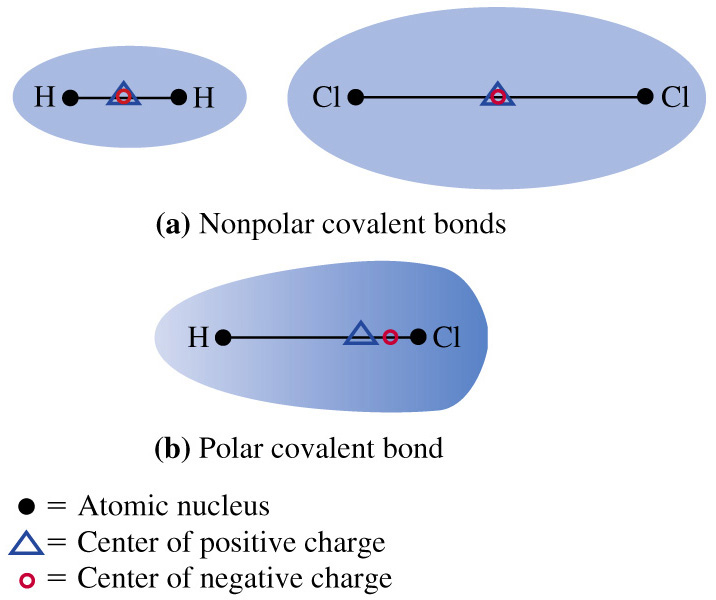
INTRAmolecular forces are found within a molecule, responsible for holding the atoms of a molecule together
INTERmolecular forces are found between the molecules, responsible for the bonding between molecules
Polarity -
Describes a molecule's electrical balance.
According to the electronegativity from each element. By subtracting two atoms in the compound. The number as a result will tell us that what kind of bonding it is.
For example:
H2O:
H: 2.20
O:3.44
3.44-2.20= 1.24
O:3.44
3.44-2.20= 1.24
Which mean H20 is a polar covalent bond according to the electronegativity.
Drawing Electron Dot and Lewis Diagrams
When Drawing Electron Dot and Lewis Diagrams, keep that in mind that
-the nucleus represents the symbol
-The dot represents the electrons
-There are four orbitals in each side, each orbital can only hold 2 maximum electrons
-Each shell can only hold 8 electrons
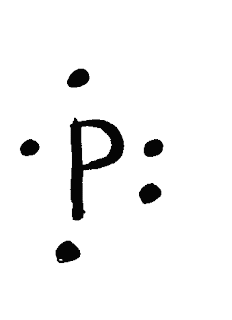 Electron dot diagrams help us to understand and represent the process of ion formation, and also illustrate that ionic bonds tend to produce full outer orbits of electron
Covalent Bonds:
 Lets use water as an example, covalent bonds are composed by 2 non-metal atom as we've learned from previous classes. When we are doing it, remember:
 - Fill each orbital into full shell
- Use line instead to replace the dot to represent the orbital is full
- Use the symbol to represent the nucleus.
Lets move on in to Ion bond.
 Basically it's the same format, but please remember both elements are not SHARING electrons. So we use "+" to represents that they are joined together still, but not covalent bonds.
-the nucleus represents the symbol
-The dot represents the electrons
-There are four orbitals in each side, each orbital can only hold 2 maximum electrons
-Each shell can only hold 8 electrons

Covalent Bonds:

- Use line instead to replace the dot to represent the orbital is full
- Use the symbol to represent the nucleus.
Lets move on in to Ion bond.
Sunday, 15 May 2011
Trends on the Periodic Table
As we look at our periodic table all the time, it's time to learn about its Trend..... yea... I know... let's do it!
 From left to right across the table are metallic to non-metallic, which are metal to non-metal
-As they going down, they will be more likely metal.
Atomic Radius:
 The Atomic radius will decrease from the left to right,
and increase from the top to bottom.
Reactivity:
 The reactivity is increasing from the middle to left and right,
- from the top to the bottom in metallic group
- from the bottom to the top in non-metallic group
Melting and Boiling Point:
 The middle of the periodic table has the highest melting point,
and it'll gradually decrease from the middle to the right and left side of the periodic table.
Ionization energy: (energy needed to be removed)
 Ionization energy increases from the left bottom to the top, and from the left to the right.
Basically, Fr has the lowest ionization energy and He has the highest.
Electronegativity:
 The Electronegativity increases from the left bottom to the top, and from the left to the right.
- its trend are same as ionization energy !
Metallic:
-As they going down, they will be more likely metal.
Atomic Radius:

and increase from the top to bottom.
Reactivity:

- from the top to the bottom in metallic group
- from the bottom to the top in non-metallic group
Melting and Boiling Point:

and it'll gradually decrease from the middle to the right and left side of the periodic table.
Ionization energy: (energy needed to be removed)

Basically, Fr has the lowest ionization energy and He has the highest.
Electronegativity:
- its trend are same as ionization energy !
Saturday, 14 May 2011
Valence Electron and Core Notation

Core Notation:
As we know that, writing a complete electron configuration takes a bit time and it's easy to make mistakes even we memorize it. So Core Notation can save us sometimes.
Basically it uses another element from the group "Nobel gas" before itself to replace the first part of electron configuration, and doesn't affect the electrons number of the original atom.
For example:
Electron Configuration : Al = 1s2 2s2 2p6 3s2 3p1
Core Notation: Al = [Ne] 3s2 3p1
Electron Configuration: O = 1s2 2s2 2p4
Core Notation: O = [He] 2s2 2p4
Electron Configuration : K = 1s2 2s2 2p6 3s2 3p6 4s1
Core Notation : K = [Ar] 4s1
little notes: the number of the noble gas is actually repersenting the first part of the electron configuration, so once they add up, the electrons number won't be affected as a result.

In chemistry, valence electrons are the electrons of an atom that can participate in the formation of chemical bonds with other atoms. Basically, as we know from the Bohr diagram, to be able to achieve a reaction, both reactant needed to have either Open shell or Closed shell to allow or provide electrons. And to predict the valence electrons, we used to draw a diagram, but now we have one more method from electron configuration.
Frist we have to know the role, valence electrons are not counted in the d- and f- subshells. which only refer to s- and p-.
For example:
Electron Configuration : Al = 1s2 2s2 2p6 3s2 3p1
Core Notation: Al = [Ne] 3s2 3p1
From here [Ne] 3s2 3p1, 2 + 1 = 3
so the valence electrons are 3 from Al
Electron Configuration: O = 1s2 2s2 2p4
Core Notation: O = [He] 2s2 2p4
Valence electrons = 2 + 4 = 6
Electron Configuration : K = 1s2 2s2 2p6 3s2 3p6 4s1
Core Notation : K = [Ar] 4s1
Valence electrons = 1
Friday, 13 May 2011
Electron Configuration
As we used to draw Bohr diagram to predict the way of electrons display, it somehow takes me a bit of time to figure out the answer. But now, we're going to learn about a new method, Electron Configuration.electron configuration is the arrangement of elecrons of an atom, a molecule, or other physical structure. It concerns the way electrons can be distributed in the orbitals of the given system.
First of all, we have to know what is "Shell",
it is a value of N and Subshell is a set of orbitals of the same type, which are "s, p, d, f" that we are going to use it to show how it works.
Basically, we use these terms "s, p, d, f" to show electrons in the atom.
Let see what's the difference between them!

n=1 s-type > can fill 2 electrons
n=2 s, p type > can fill 6 electrons
n=3 s, p, d type > can fill 10 electrons
n=4 s, p, d, f type > can fill 14 electron
And now lets take a look the order of their pattern

So, the pattern is 1s2 > 2s2 > 2p6 > 3s2 > 3p6 > 4s2 > 3d10........................
And now we can do some excerises!
Oxygen, with 8 electrons. > 1s2 2s2 2p4 : 2+2+4 = 8 (little notes, s,p,d,f doesn't have to fully fill)
Calcium, with 20 electrons. > 1s2 2s2 2p6 3s2 3p6 4s2 : 2+2+6+2+6+2 = 20
Lithium, with 3 electrons. > 1s2 2s1
Sulphur, with 16 electrons. > 1s2 2s2 2p6 3s2 3p4 : 2+2+6+2+6 = 16
First of all, we have to know what is "Shell",
it is a value of N and Subshell is a set of orbitals of the same type, which are "s, p, d, f" that we are going to use it to show how it works.
Basically, we use these terms "s, p, d, f" to show electrons in the atom.
Let see what's the difference between them!

n=1 s-type > can fill 2 electrons
n=2 s, p type > can fill 6 electrons
n=3 s, p, d type > can fill 10 electrons
n=4 s, p, d, f type > can fill 14 electron
And now lets take a look the order of their pattern

So, the pattern is 1s2 > 2s2 > 2p6 > 3s2 > 3p6 > 4s2 > 3d10........................
And now we can do some excerises!
Oxygen, with 8 electrons. > 1s2 2s2 2p4 : 2+2+4 = 8 (little notes, s,p,d,f doesn't have to fully fill)
Calcium, with 20 electrons. > 1s2 2s2 2p6 3s2 3p6 4s2 : 2+2+6+2+6+2 = 20
Lithium, with 3 electrons. > 1s2 2s1
Sulphur, with 16 electrons. > 1s2 2s2 2p6 3s2 3p4 : 2+2+6+2+6 = 16
Thursday, 5 May 2011
Atomic Theory
Aristotle 384 BC – 332 BC
ž1 Aristotle believed an ancient Greek theory that atom
being different sizes, regular geometric shapes
and being in constant motion.
ž
- believed that matter was made of different
- combo of earth, air, fire and water. They represent four
- qualities: dryness, hotness, coldness, and wetness. He didn’t really contribute much to the atoms
Democritus Contribution

- He suggested that matters are made up of atoms, which we are still using this concept today. However, he never made any attempt to determine whether his theory was correct.
Antoine Lavoisier 1763

žHe named oxygen.
žalso proposed the Law of Conversation of Mass
which represents the beginning of modern chemistry
John Dalton 1766 - 1844

žJohn Dalton is considered the Father of Modern Atomic theory.
ždiscover the partial pressures of gases. This major advance in stoichiometry, the ratio of elements, lead to his formulation of a working theory of the atom.
J.J. Thomson 1897

žhe showed that cathode rays are rapidly moving particles, and, by measuring their displacement by electric and magnetic fields,
he determined that these particles were nearly 2,000 times less massive than the lightest known atomic particle,which now what we call,
electrons.

Ernest Rutherford 1909
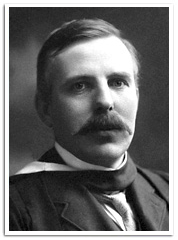
ždiscovered that there were different types of rays; Alpha, Beta, and Gamma
ždiscovered that radioactive elements have half-life which can be used to find the age of an element and this method still be using widely today.

Niels Bohr 1885 - 1962

žThe Bohr Model is an approximation to quantum mechanics that has the virtue of being much simpler. He postulated based on quantum theory that electrons travel around an atomic nucleus in a stationary orbit. His work also led to the theory of different energy levels in atoms that is if an electron drops from a higher to a lower orbit, it must release energy.
Subscribe to:
Posts (Atom)